AI-assisted Rules as Code
Assemblic Codify
Turn legislation into tested, validated OpenFisca code, faster — with subject matter experts reviewing and approving every key step.
The problem it solves
Getting from legislation to code was the bottleneck
A traditional Rules as Code project follows four stages: discovery and logic mapping, OpenFisca build and coding, frontend build, and testing. The first two stages — turning legislation into rules statements, visual logic maps, questions and test cases — have traditionally been the most time-consuming part of the process, and a major barrier to Rules as Code adoption worldwide.
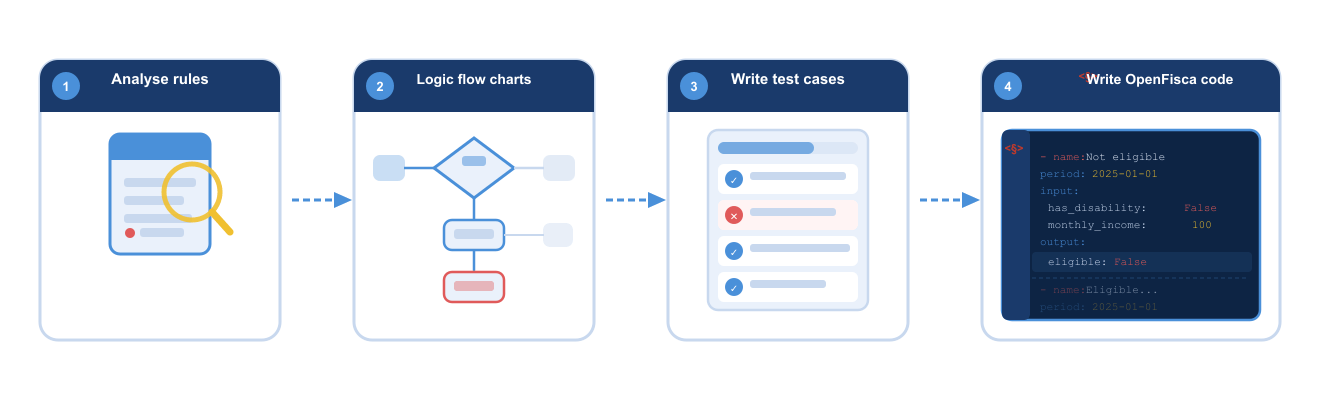
Assemblic Codify automates much of this work. Codify takes legislation and rules, maps them into visual logic diagrams, creates test cases, writes OpenFisca code, and validates that code against the test cases.
AI drafts. Humans decide.
AI is not making decisions in Assemblic Codify — it produces logic for human review and input. Subject matter experts check the flow chart, review the test cases and outputs, and an OpenFisca expert reviews the final code against the flow chart, test cases and OpenFisca best practice before anything is exported.
Citizens and other users interact with the reviewed, human-approved code — not the AI.
How it works
From legislation to reviewed OpenFisca code
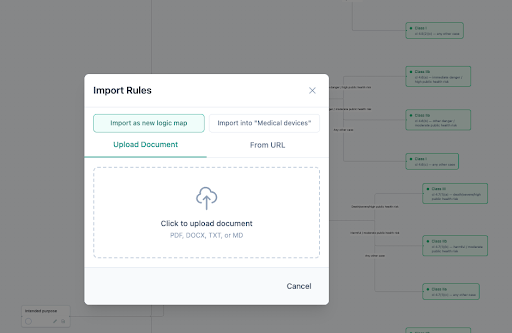
Upload the legislation
Start with a PDF of the legislation, or point Codify at the URL(s) where it's published. Import it as a new logic map, or add it into an existing project.
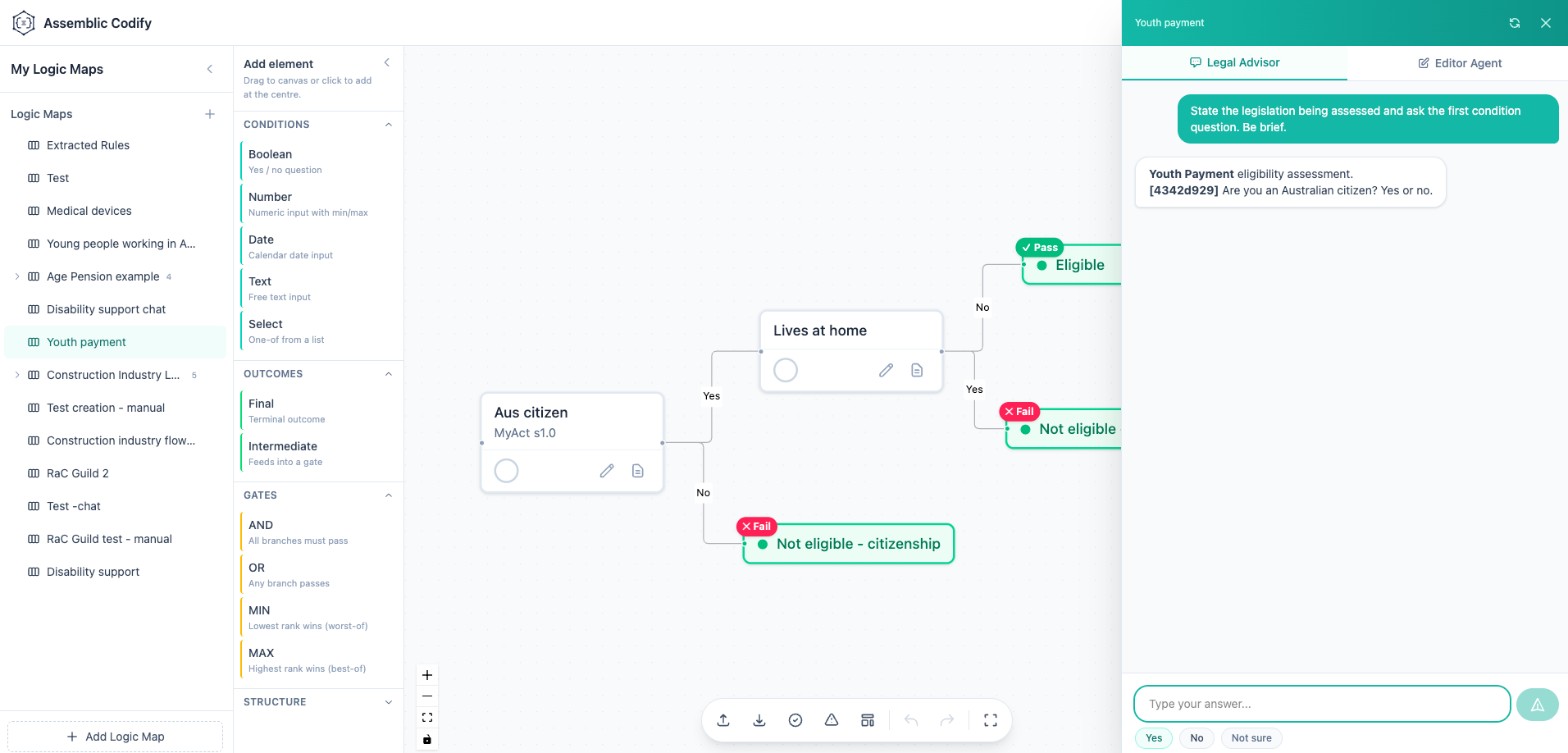
AI drafts the logic map
Codify's Legal Advisor works through the legislation with you, drafting eligibility and entitlement logic as a step-by-step conversation you can follow and direct.
Build and edit visually
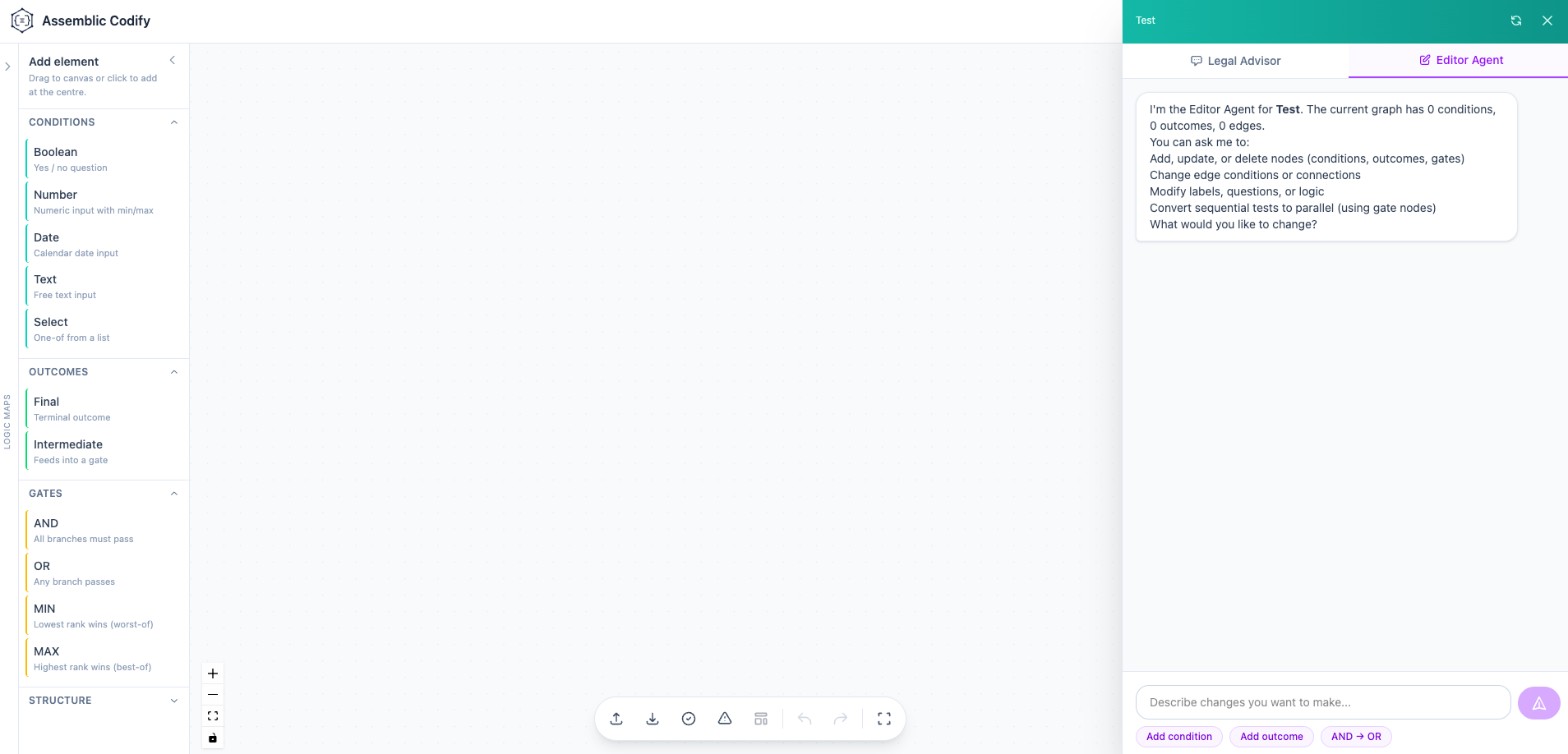
Start a logic map from a blank canvas, or adjust the AI's draft directly, with the Editor Agent on hand to help make changes.
Experts review the flow chart
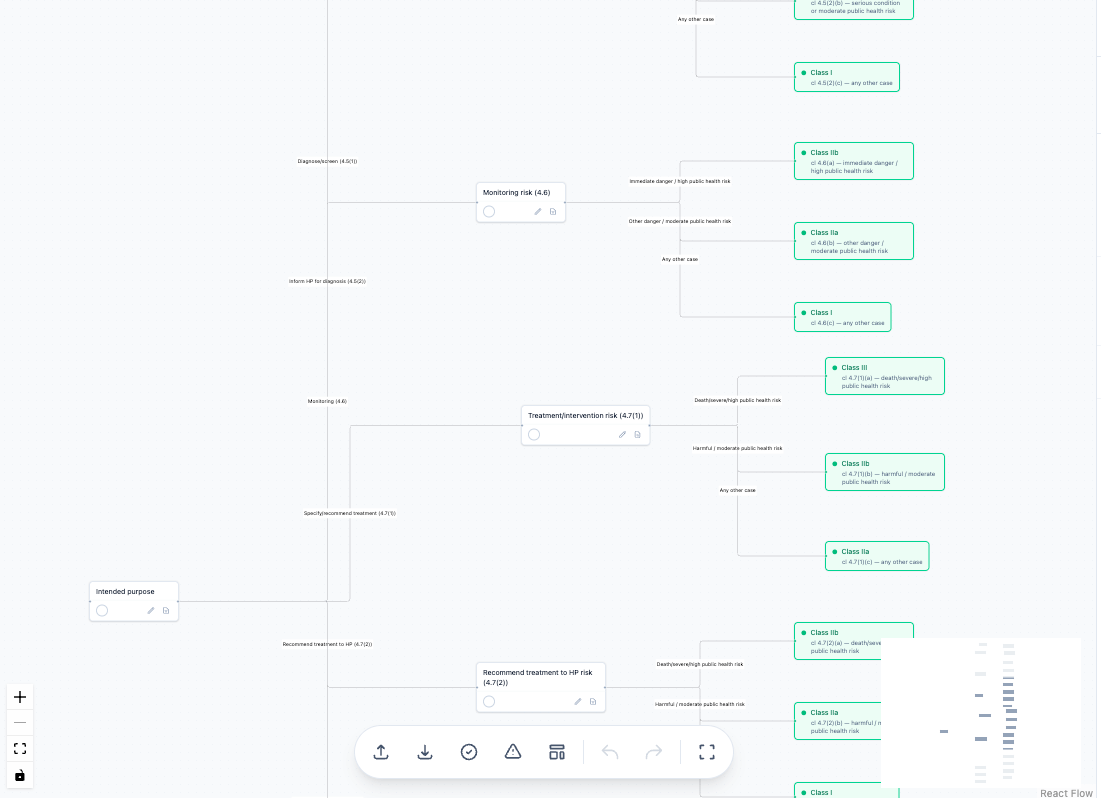
The logic becomes a visual flow chart referencing the source clauses. Subject matter experts review it closely and make any changes needed before test cases are produced.
Generate and validate test cases
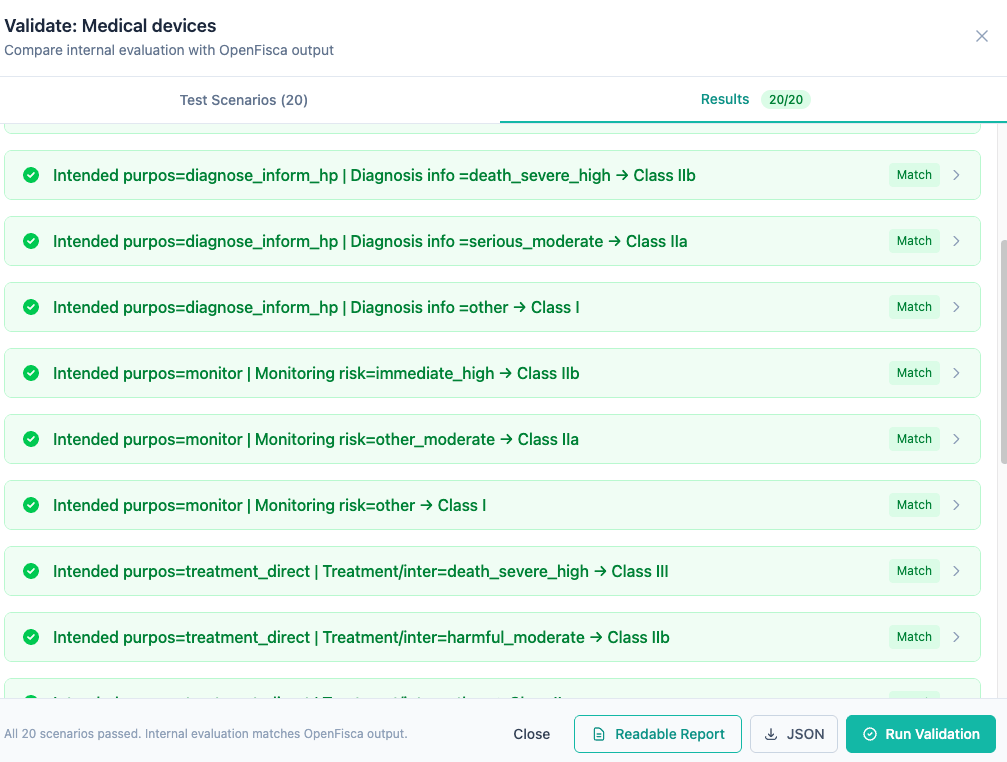
With one click, Codify produces test cases from the flow chart, then validates them against the generated OpenFisca code — automatically checking that the code matches the logic experts approved.
Export to OpenFisca and Assemblic
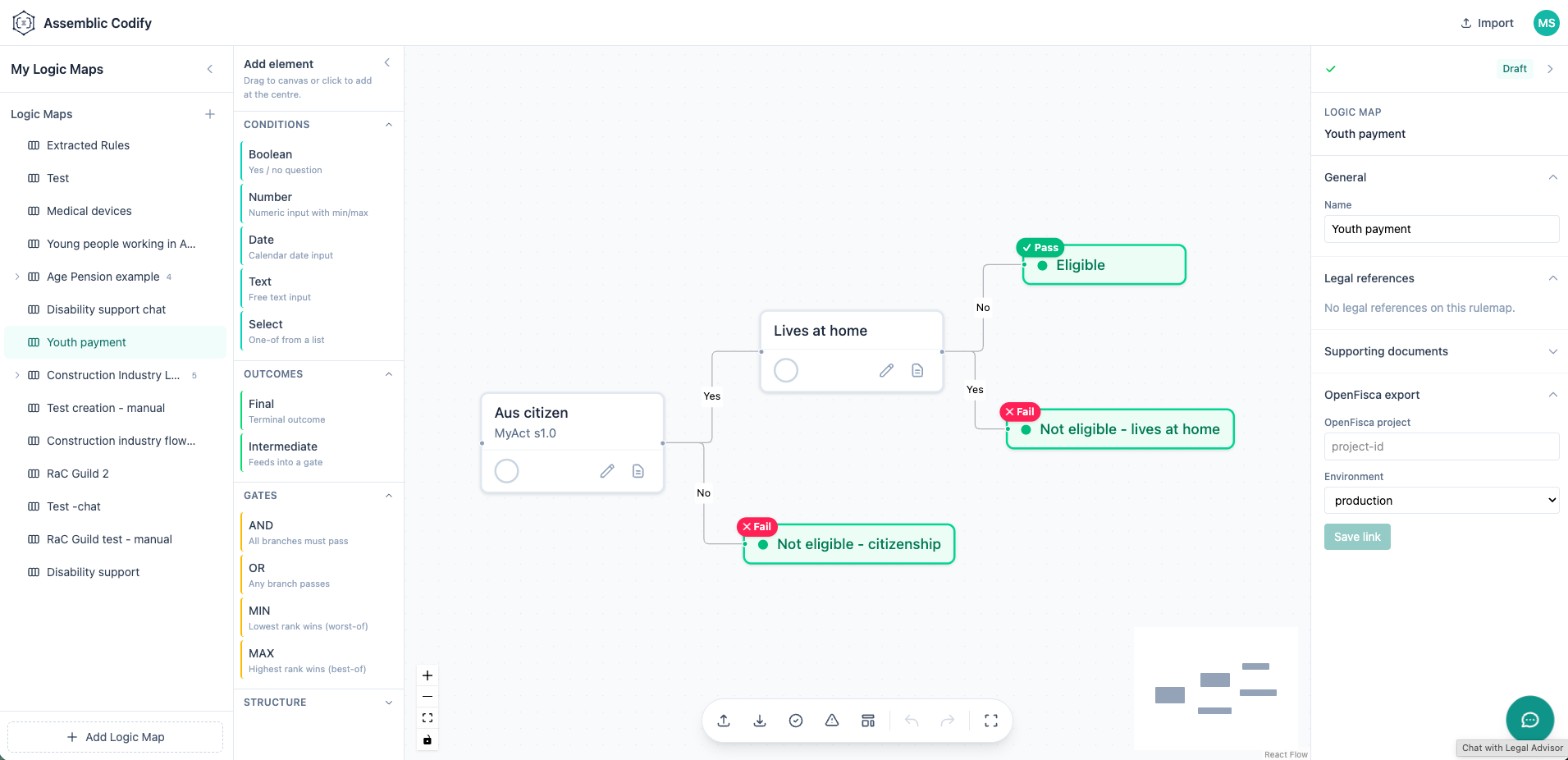
Once an OpenFisca expert has reviewed the code against the flow chart, test cases and best practice, export it with one click straight into your Assemblic project and environment.
Why it matters
What Rules as Code and OpenFisca provide
Rules as Code is the practice of expressing legislation and policy as structured code. OpenFisca is a mature, open-source rules engine purpose-built for encoding eligibility and entitlement rules and exposing them as a queryable API, already used by governments internationally to model tax, benefit and eligibility systems.
A single source of truth
Rules are encoded once, and every channel returns the identical answer — the citizen portal, the contact centre, partner agencies and AI assistants all draw the same determination from the same source.
Explainability
Every answer can be traced to the specific rule and the section of the Act that produced it. Determinations are not opaque — they are auditable and citable.
Versioning, backward
Because the rules are version-controlled, the system can answer not only "what does the law say now?" but "what did the law say on a given date?"
Future-modelling, forward
Proposed amendments can be encoded as a draft version and tested against real scenarios before they commence, quantifying their effect in advance.
The source of truth for AI
The most effective defence against confidently-wrong AI is not to ban it, but to ground it — to give it an authoritative source it must consult before answering. When an AI assistant is asked a question, instead of generating an answer from memory, it can call an OpenFisca API built with Assemblic Codify, receive a definitive determination, and present that — turning a government's interpretation of the law into the authoritative reference AI must defer to.
- • Citable answers, anchored to the encoded rule and the section of the Act
- • Guardrails against hallucination — the API constrains the AI to the legislated position
- • Human and machine parity — everyone receives the identical determination
- • Currency — versioned APIs always reflect the law in force
Ready to accelerate your Rules as Code project?
Assemblic Codify is available as an add-on to any Assemblic plan. See current pricing or talk to our team about your project.